"Wir sind Papst!"
Events leading to a German glimpse of healthy nationalism, 2005-2006

Millions mourned the loss of Pope Benedict XVI earlier this year. I was one of them.
His passing led me to recall living in Germany in 2005, the year he became pope. The months leading up to Cardinal Ratzinger earning the requisite two-thirds of his fellow cardinals’ votes to become pope were indeed momentous. Perhaps more momentous for German identity, and German civil and patriotic identity, were the months immediately following his April 2005 consecration,
That year marked a confluence of five things painting Germany as a world leader.
1. Cardinal Ratzinger became Pope Benedict: There emerged a sense of German accomplishment, at least tacitly, when Ratzinger became the 265th leader of the world’s largest church.
2. Economics: Germany once again heralded the third highest GDP in the world.
3. Anti-Americanism: It ran rampant at that time, having (re)emerged with George Bush’s push for a war in Iraq, which worked to unite most Germans against it.
4. Angela Merkel: She was about to become the nation’s first female chancellor.
5. Soccer (football) World Cup: Germany hosted the 2006 FIFA World Cup the following year, only the second time ever in the nation’s history.
What do GDP, anti-Americanism, a new chancellor, and hosting a soccer world championship have to do with the pope? Answer: a ubiquitous sense of healthy national pride for the first time since the Weimar Republic – if not earlier.
Germans generally did not celebrate national achievements after World War II the way Americans — or even Canadians or French — did. There was no flag waving of note, very little singing of national anthems. Many who were born immediately before or during World War II (Kriegskinder) shared the same sentiment with me in numerous conversations: “A person should not be proud of his nation, only of his personal accomplishments.” A healthy post-war sense of nationalism had not yet been born in 2005.
Pope Benedict XVI
On April 19, 2005, the white smoke gushed from the chimney of the Sistine Chapel. From the Vatican it was announced, “Habemus papam!” We have a pope! This particular Holy Father, then-Cardinal Joseph Ratzinger, would take the papal name of Benedict XVI and become the first German pope since Stephen IX in 1057. Having a German selected to lead the world's largest and most influential church in 2005 proved to be more than a religious symbol. It was a secular one, one of German pride. The political commentary on how the newly minted Teutonic pope abounded throughout the spring and summer of 2005. Perhaps the quintessential example was found in the newspaper Bild, a newspaper perhaps best known gossip and its Seite-1-Mädchen, Page-1 topless girls. From 1984 until 2012, the paper featured topless women. But, on April 20, 2005, the paper featured nothing for prurient purposes. Instead, it proclaimed, “Wir sind Papst!” — We are Pope! Ironically, on Hitler’s birthday, this paper announced to the world that Germans and Germany was pope.
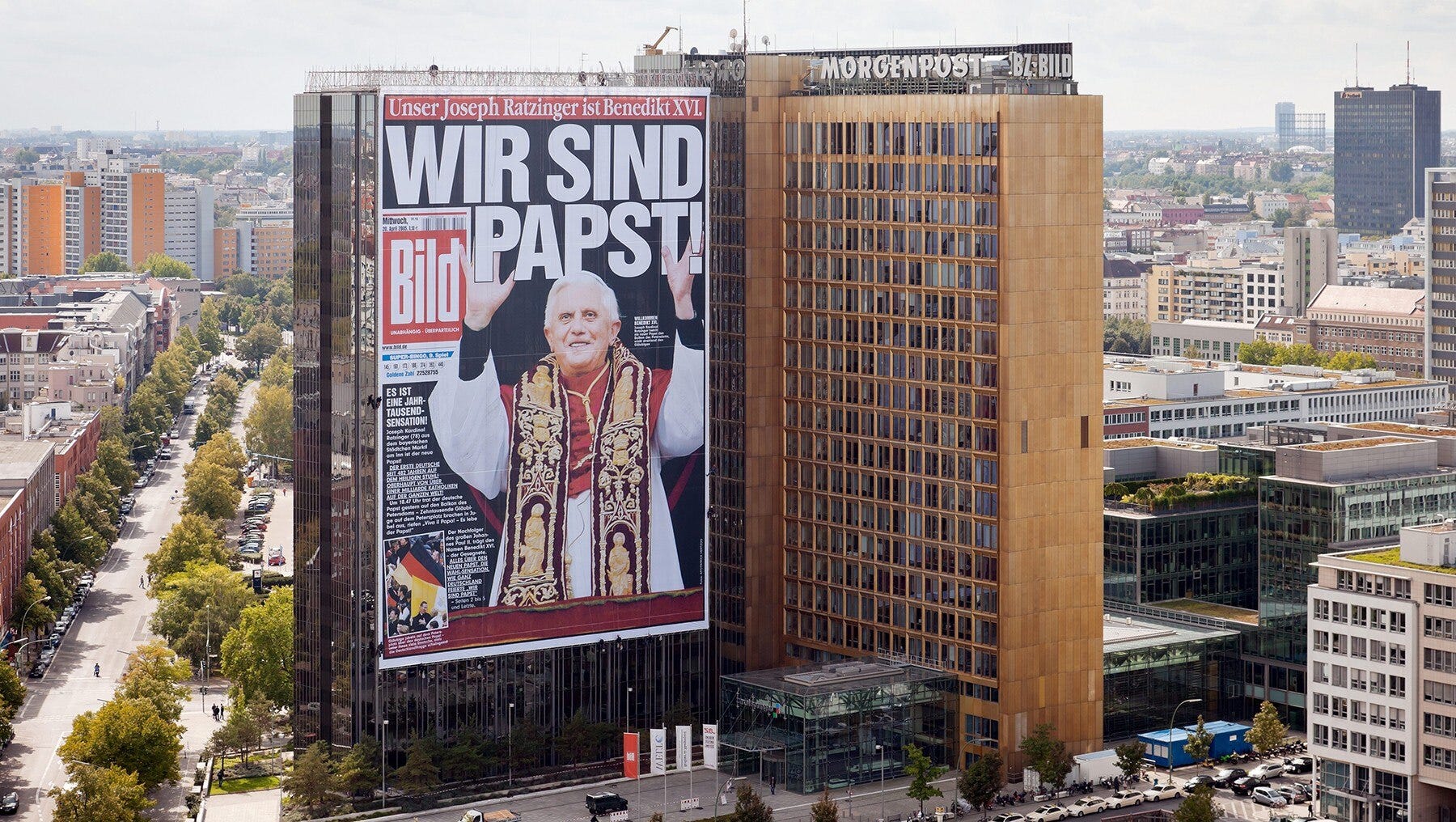
A greatly enlarged image of famed title page of the April 20, 2005 edition of Bild hanging on the facade of the Axel-Springer-Gebaeude, Bild headquarters, in Berlin.
I will never forget it. The palpable significance of Germans rallying around Pope Benedict as a symbol of their collective goodness could not be missed. A copy of that paper, one to which I never subscribed and had never before or since purchased, hangs in my office.
German GDP
Germany, a nation of about 80 million people was the third largest economy on the planet – certainly noteworthy. A nation the geographical size of Minnesota was, per capita, a world-leading economy.
This economic prowess, especially in the tech, automobile, chemical, and pharmaceutical sectors propelled Germany into an era of economic good feelings. Sure, 2005 boasted a high, 11.5% unemployment rate. But, by year’s end, that number had already peeled off a point, continued to drop. Germany has not experienced a 10%+ unemployment rate since.
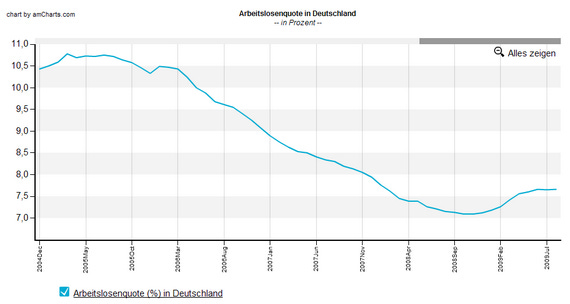
With most Germans enjoying economic prosperity in those times, there was a collective sense of ease. Their collective ire would instead be focused elsewhere, especially on the United States.
Anti-American sentiment
Germany had become a global player in multiple realms for the first time since the Cold War in 1990, and the subsequent American troop draw down had concluded, for the most part, by the turn of the millennium. May Germans asked the remaining “Amis” (Americans) to “go home”.
Like Ernst Busch sang,
Go home, Ami! Ami go home!
Leave the German river in peace
Because for your "Way of Life"
You can't win us over. . .
That Anti-American sentiment had only strengthened since the mid-twentieth century when Busch wrote his lyrics articulating German complaints about American presence in and influence over his country. The chief complaint became America’s 2003 intervention in Iraq.
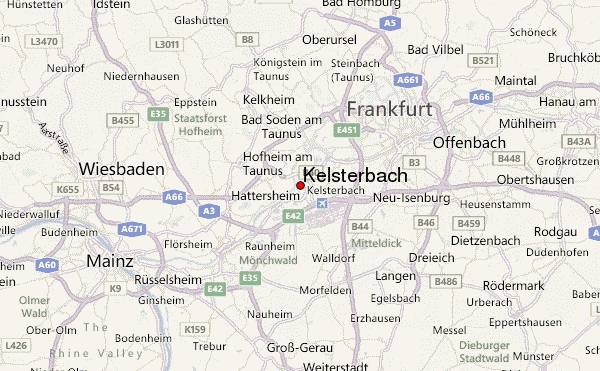
I still recall sitting in a Kelsterbach office building when President George W. Bush took his February 2005 visit to Mainz, about 20 miles away.
Source: https://www.weather-forecast.com/locations/Kelsterbach/forecasts/latest
The protests were large, the Anti-Americanism discernible.
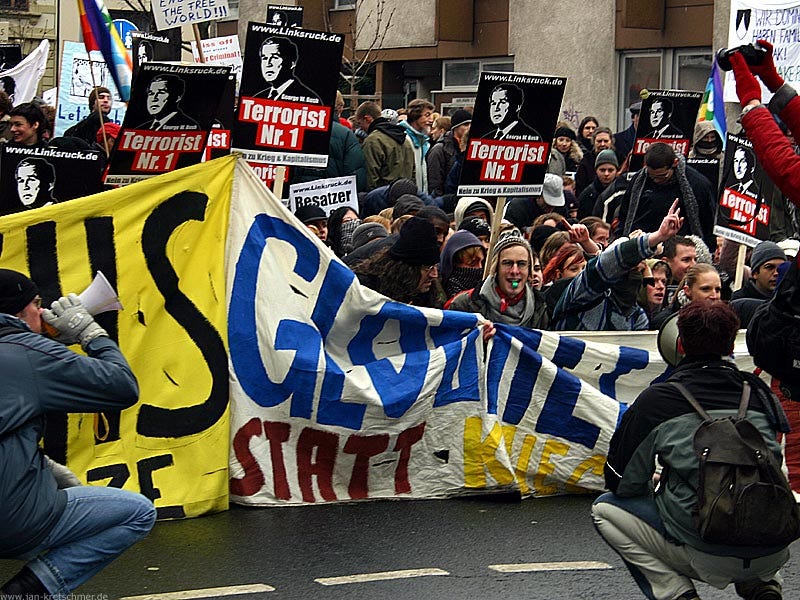
Source: http://www.jan-kretschmer.de/photo/bush_in_mainz05.htm
As uncomfortable as the anti-Americanism was for this American and many others, it helped set the stage for a new German nationalism. Ironically, it proved to be a relatively healthy one. It was no longer a mere neo-Marxist or pacifist brand of anti-Americanism. It was one ensconced in a place where Germans could start thinking of their role on the world stage without fear of being called a Nazi looking to take over the world. This seemed acceptable to those who, like the French, might have once viewed Germany through a skeptic’s lens due to Germany’s troublesome past. The political body of the European Union, and Germany buying so much into it, progressed into a respected institutional check on fascist, nativist nationalism. As German political scientist Kurt Sontheimer explained in his 2001 lecture at the University of Edinburgh Law School explained: “European identity is German identity.”
It is fair to say that, at the time, Germans united in their disdain for many things American, not only its policy. Concurrently a zeitgeist emerged, fostered by Germany’s existing progressive brand of capitalism, one that included more sozial, or egalitarian business and social policies (like five weeks of annual vacation being rather standard for full-time employees). That, coupled with Germans deeper secularism and a wide-spread environmental movement, created an atmosphere of considerable mutual cultural understanding. It fostered an environment within which a new nationalism could grow. Now, Germans needed a leader to care for it, to help its healthier sense of its political self for continuing its economic growth and increased international influence.
Rise of Merkel to the chancellorship
Dr. Angela Merkel initially trained as a physicist during the Cold War in what was then the Democratic German Republic, what most people knew as communist East Germany. Gravitating to politics after the Cold War ended, she entered the orbit of Chancellor Helmut Kohl, who was the German leader when the Berlin Wall fell. Kohl was tasked with uniting the five East German states with the eleven western ones, a tall order.
Moving up the ranks, Merkel eventually became the successful Christian-Democratic Union candidate for the chancellorship. In fall of 2005, she took the helm to great acclaim.
Merkel’s controlled demeanor and relaxed attitude forged the perception of international power. As German Parliamentarian Johann Wadephul put it in 2017, Merkel was “the international leader, and we Germans are proud of it.”
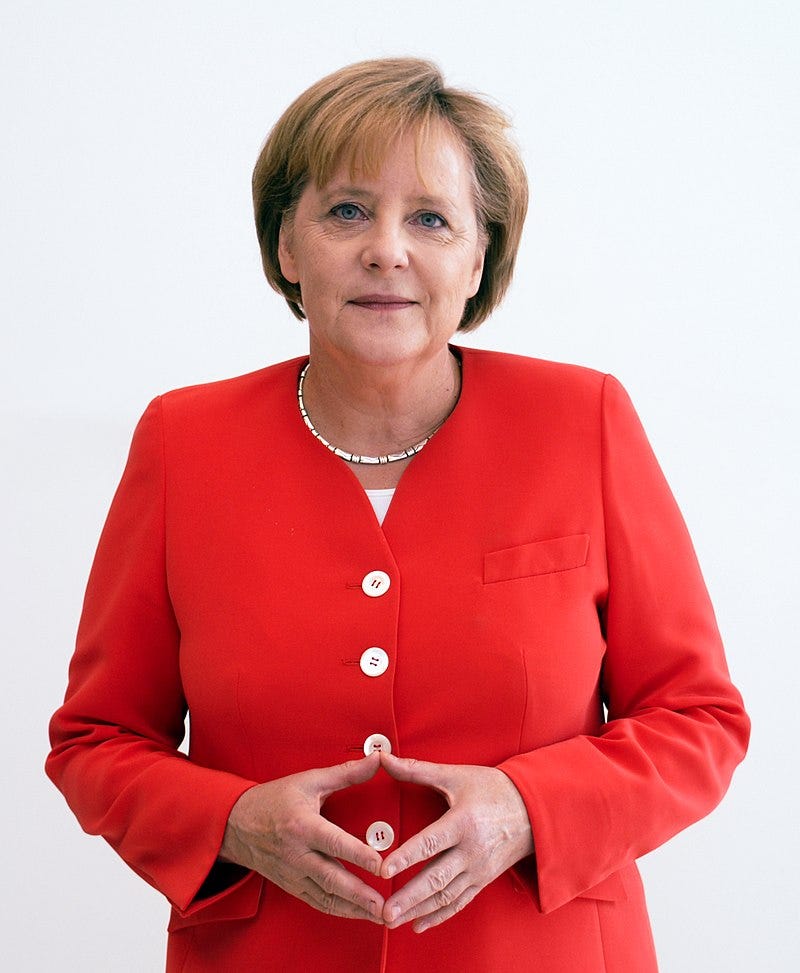
She, perhaps unwittingly, oversaw the confluence of economic, social, and political events that were fusing a stronger Germany. She played the role of stateswoman well. Always poised, she also shared her wry humor with a public open to receiving it.
One anecdote helps to illustrate her wit. She had been assigned extra police protection for an international sporting event. When she arrived at the venue, she slowly scanned the room. A bit taken back by the manpower, she then calmly looked at the commanding officer and quipped, “Who do you think I am? [President] George Bush?”
2006 FIFA World Cup
Speaking of soccer, in 2000 Germany was chosen to host the 2006 World Cup. Though there were accusations of some crooked doings in the bidding process, Fédération Internationale de Football Association (FIFA) still allowed Germany to host, and a wonderful host they were.
As for soccer, not only was Germany hosting the World Cup, it was also considered strong enough to win. They entered the tournament seeded fourth in the world. Ending up in third place, they fared well.
More remarkable was not what happened on the pitch but what happened outside the stadiums. Germans began doing something they had not done widely for decades. People started hanging German flags out of their windows. For Americans, this is no big deal. We say the anthem at most sporting events, and flags not waving would be, well, weird. Not the case in Germany.
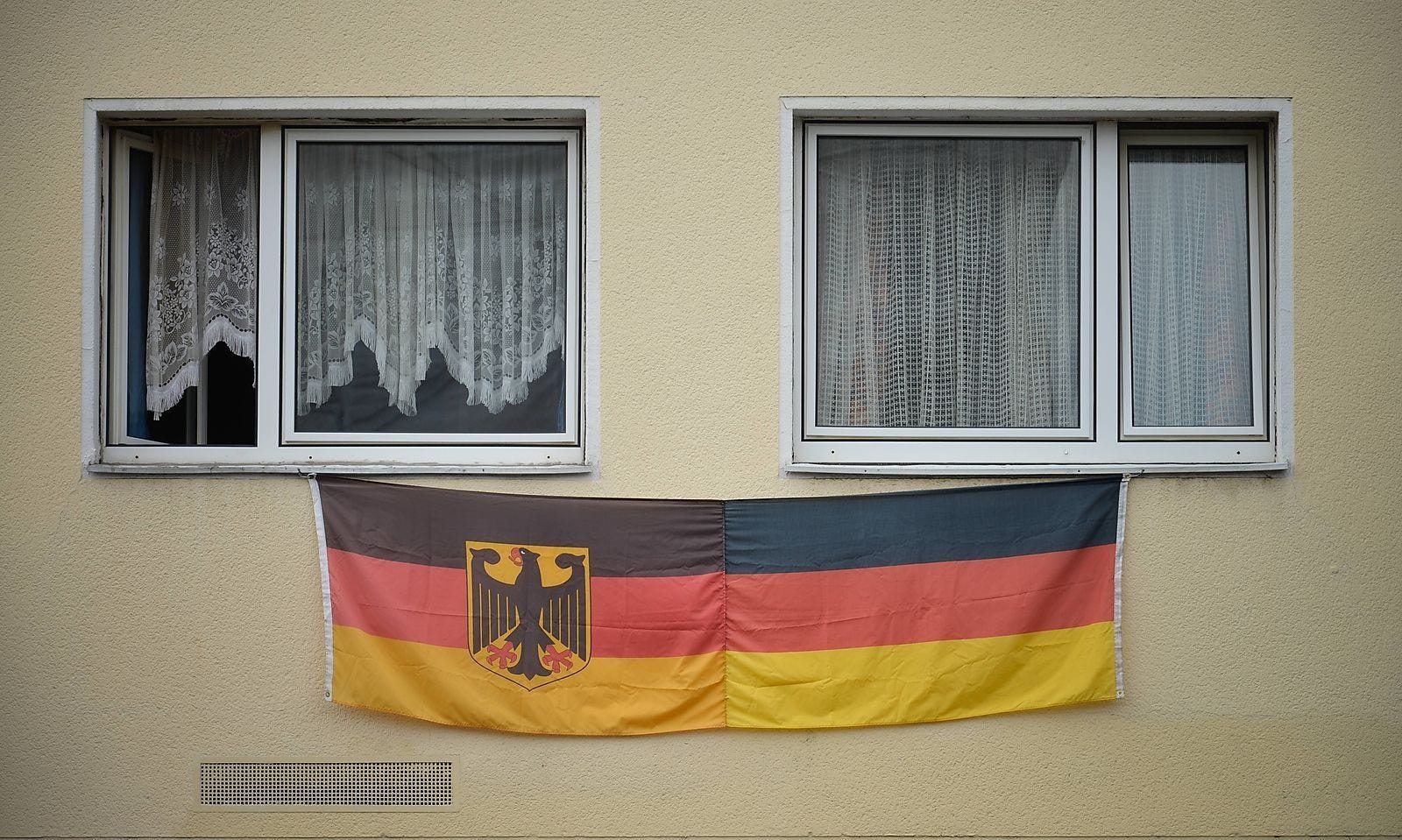
After World War II, nationalism was generally equated with Naziism. The world Stolz, or pride, was looked askance, and one looked at personal accomplishments our beyond his shores for a sense of pride. Being proud of your nation and waving a flag to show it? That was not accepted until the 2006 World Cup. Soccer supporters of all ideologies and persuasions slowly began hanging little German flags out of their windows. The sense of healthy pride could be felt to be sure. As a June 2006 New York Times article made plain, “This represents a change, ‘a cathartic moment for Germany,’ as one longtime foreign observer, Gary Smith, director of the American Academy in Berlin, put it.”
Cardinal Ratzinger and all of this?
Pope John Paul II had died February 1, and the press had begun floating Cardinal Ratzinger’s name within days thereafter as being the likely papal replacement. It is notable how his ascension to becoming the Holy See coincided with so many events, one that Germany had not seen since before Ratzinger’s childhood. Only this time, it was not an ascension of Germany riddled with hate. Indeed, it was quite the opposite.